
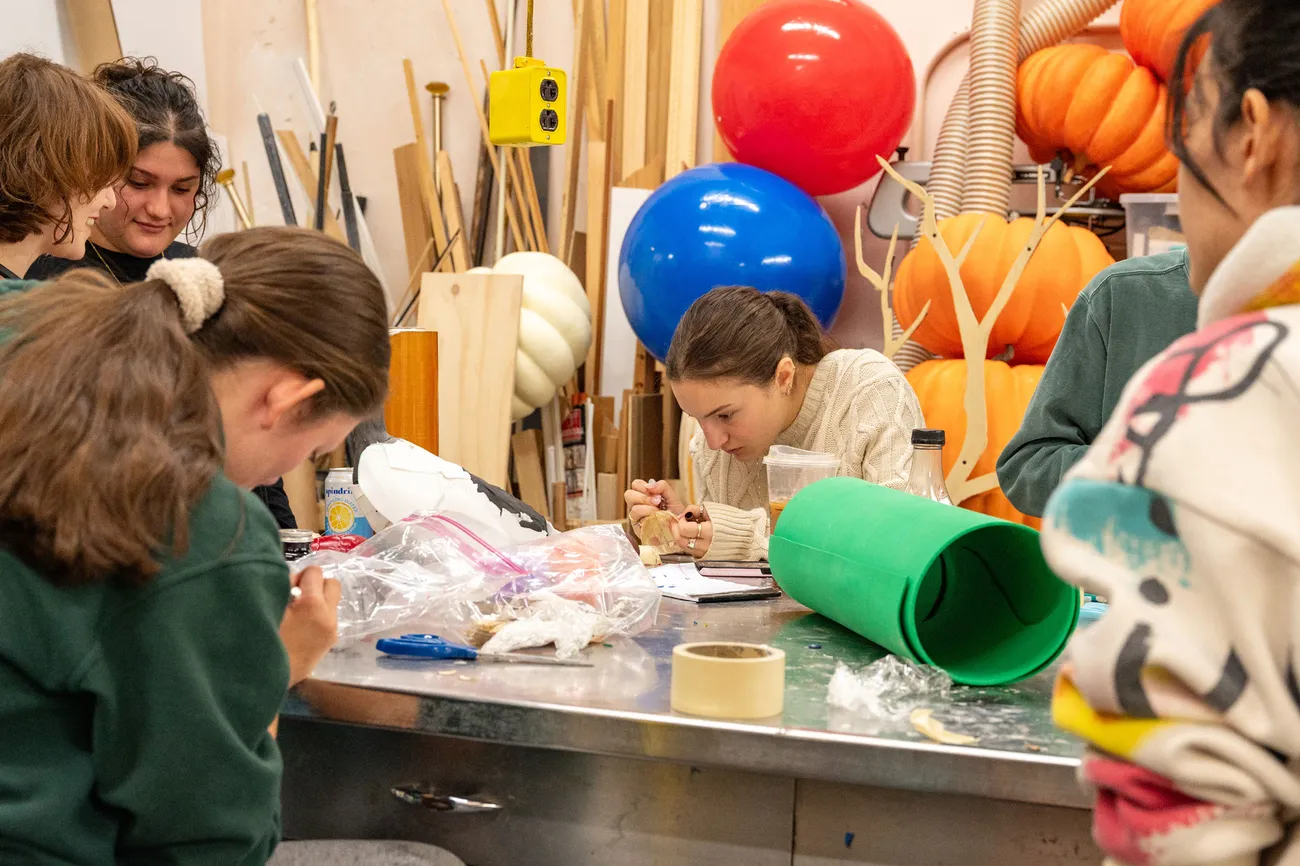
Here you will find answers to commonly asked questions about the Department of Drama’s theater design and technology (TDT) area when applying to our program. If you have any remaining questions, please email Carmen Martinez, assistant professor of theater design and technology, at cmarti46@syr.edu.
That’s completely normal—and actually a great place to start! Our program is designed with exactly this in mind. Your first year exposes you to all areas of theater design and technology: scenic, costume, lighting, sound, etc. Many students come in thinking they want to do one thing and fall in love with something completely different once they experience it hands-on.
And if you are interested in more than one discipline, that is great too! Knowing and understanding multiple disciplines makes you a stronger designer and collaborator. You don’t have to pick one path right away—we encourage exploration. See the question below about our overall curriculum.
Our TDT curriculum follows a progressive model, meaning each course you take prepares you for the next level of study. You’ll start with foundational courses in your first year that introduce essential skills, core concepts, techniques and safety protocols across all areas.
As you advance, you’ll specialize more deeply in your chosen concentration(s)—whether that’s scenic, lighting, costume, sound design or technical direction. This stepped approach ensures you have the technical skills and theoretical knowledge needed before taking on more complex design challenges and production responsibilities.
Production assignments are also curricular. This means you will fulfill required experience credits by working as a designer or assistant designer on Department of Drama productions.
The first year is all about building a strong foundation! Students come into the program with varying levels of experience: some have been doing theater for years, and others have just discovered it. We like to think of the first year as an opportunity to even out the playing field where at the end of their first year, the cohort is prepared with the same set of tools to succeed during their time at Syracuse University.
Generally, first-year students take courses in drawing, art and design history, dramatic literature, introductory design classes and a class taught by the shop heads of Syracuse Stage, where students spend a few weeks in each department.
We’re committed to making sure you feel welcome and supported from the moment you arrive! Beyond academic advising with faculty, each area within the department has a student representative. The reps are elected by the students in each area and serve as the liaison between the student body and the faculty. They are also in charge of setting up the Big/Little Program: once you commit to the department, the reps send out a survey to all incoming students, and based on your answers you get paired up with a family made up of current students. They become your go-to persons for questions about classes, productions and campus life. The faculty maintain open-door policies and genuinely care about your success. Our tight-knit community means you’ll quickly get to know students across all class years, and everyone looks out for each other. You’re joining a theater family, not just a major!
Syracuse University and the College of Visual and Performing Arts (VPA) have fantastic study abroad and away programs, and drama students have participated in programs in London, Florence and other locations around the world. While timing requires planning due to production schedules and prioritizing your learning goals, many students successfully study abroad—especially during summer sessions or by coordinating carefully with advisors. Some programs even have theater components built in.
Additionally, you might explore semester-away opportunities in places like New York City or Los Angeles through VPA’s programs. The key is to talk with your advisor early about your interest so you can map out the best timing that works with your degree requirements and production commitments.
Our students are involved in productions starting in the spring of their first year! In your first year, you’ll work on productions in various crew positions, and as part of class you work a lighting focus for a Department of Drama mainstage production.
Because we are a B.F.A. program and don’t offer graduate degrees, our students will ideally design all productions at the Department of Drama. Of course this is also a careful progression. After successfully fulfilling your crew assignment, you’ll take on assistant designer roles and smaller design projects. By your junior and senior years, you’ll have merit-based opportunities to fully design productions. Most students tend to work as lead designers for two fully supported productions (unless they choose to go abroad or away for two semesters). We believe in learning by doing, so you’ll graduate with real design credits, a professional portfolio and the experience of bringing your creative vision to life on stage.
This is one of the most exciting aspects of our program! Syracuse Stage is a professional LORT (League of Resident Theatres) theater that’s directly connected to our department. As a student, you’ll have opportunities to work alongside professional designers and technicians. You might assist on Syracuse Stage productions, attend rehearsals and technical rehearsals, and observe professional designers at work. It’s like having a professional theater as your extended classroom—an incredible learning opportunity that gives you real-world experience while you’re still a student.
Another perk to this relationship is that all the shop heads at Syracuse Stage are also instructors for the theater design and technology area. This kind of connection is something many programs simply can’t offer. Learn more about this relationship.
Yes, though it requires thoughtful planning; we want you to learn and expand your horizons as much as possible! The drama major is intensive with production commitments and credit requirements, but students have successfully combined it with minors in areas like arts management, business, communications, marketing or other fields. A double major is more challenging due to the credit load and production schedules, but it’s absolutely possible to do so in four years as long as you are able to transfer multiple AP credits. The key is to meet with your advisor early and often to create a realistic four-year plan that works for you. Many students find that a minor gives them flexibility while still allowing them to explore other interests that enhance their theater career.
During the academic year, it can be tough to accommodate off-campus internships. However, our students, if interested, are encouraged to find opportunities to assist professional designers at Syracuse Stage. Our students have interned at regional theaters, Broadway shops, theme parks (like Disney and Universal), television studios, event production companies and more. The department maintains connections with alumni and industry professionals who often reach out about internship opportunities. Your faculty and advisors are always happy to help craft a path that suits your needs and goals.
More than 81% of Syracuse University students receive aid—the majority of it in the form of grants and scholarships that do not have to be repaid.
Merit-based scholarships (money that does not need to be repaid) for undergraduate students are awarded by the Admissions Committee to recognize academic achievement regardless of financial need.
These scholarships are based on:
- Academic credentials
- Performance on standardized tests
- Class rank
- Portfolio or audition results (if relevant)
- Leadership, community and extracurricular involvement
- Overall citizenship