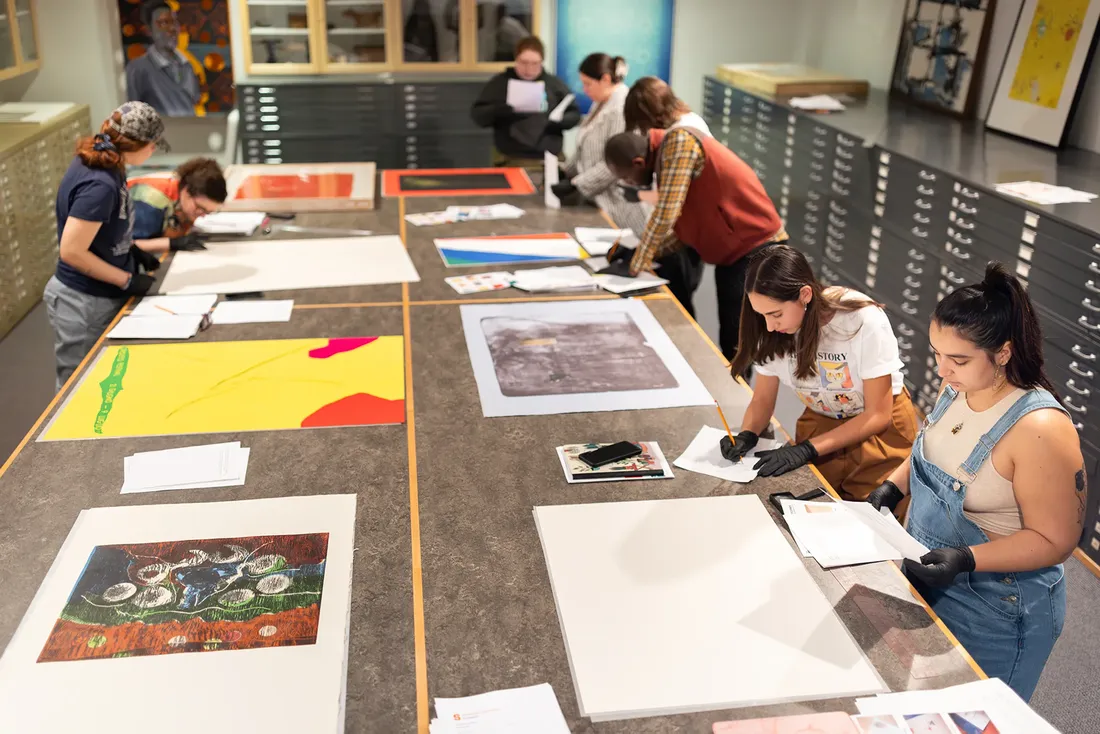
Students in the Collections Management course review the condition, dimensions and other details of the Frankenthaler prints.
As one of America’s most acclaimed 20th-century artists, Helen Frankenthaler H’85 (1928-2011) created an enduring legacy in abstraction and played an instrumental role in the development of color field painting. A tireless experimentalist, Frankenthaler worked in a variety of media beyond the canvas. In a 1993 public conversation, Frankenthaler’s approach to printmaking was described as “What if I try this? What if I try that?”
The Syracuse University Art Museum brings that description to life in its new exhibition “What If I Try This?”: Helen Frankenthaler in the 20th-Century Print Ecosystem, which explores the artist’s printmaking and collaborations with a community of printers over a nearly 50-year span. “In that phrase, we see Frankenthaler’s approach to printmaking, which is based in experimentation,” says Art Museum Curator Melissa Yuen, who organized the exhibition. “But it’s also important to know that printmaking is, in a way, fundamentally at odds with her painting practice, which is very dynamic, spontaneous, fluid. Printmaking is the antithesis of that—it’s meticulous and process oriented.”
The exhibition opened Aug. 26 and runs through Dec. 9, with an opening celebration on Sept. 11. One highlight of the celebration is a talk by Stanford University professor and art historian Alexander Nemerov, author of Fierce Poise: Helen Frankenthaler and 1950s New York (Penguin Press, 2021).
The exhibition features 56 works—prints, paintings, photographs and letters—by Frankenthaler and her contemporaries, including 11 prints and one set of process proofs gifted to the Syracuse University Art Museum in 2023 by the Helen Frankenthaler Foundation. Among the pieces, Yuen borrowed 24 works from national and area collections and drew on Frankenthaler’s correspondence with artist Grace Hartigan, whose papers are held in the University’s Special Collections Research Center.
“We are thrilled to share this exhibition and related programming with our students, faculty and the broader community,” says Art Museum Director Emily Dittman G’06. “Our museum’s inclusion in the second cohort of the Frankenthaler Prints Initiative creates new opportunities for teaching, research and public engagement.”