
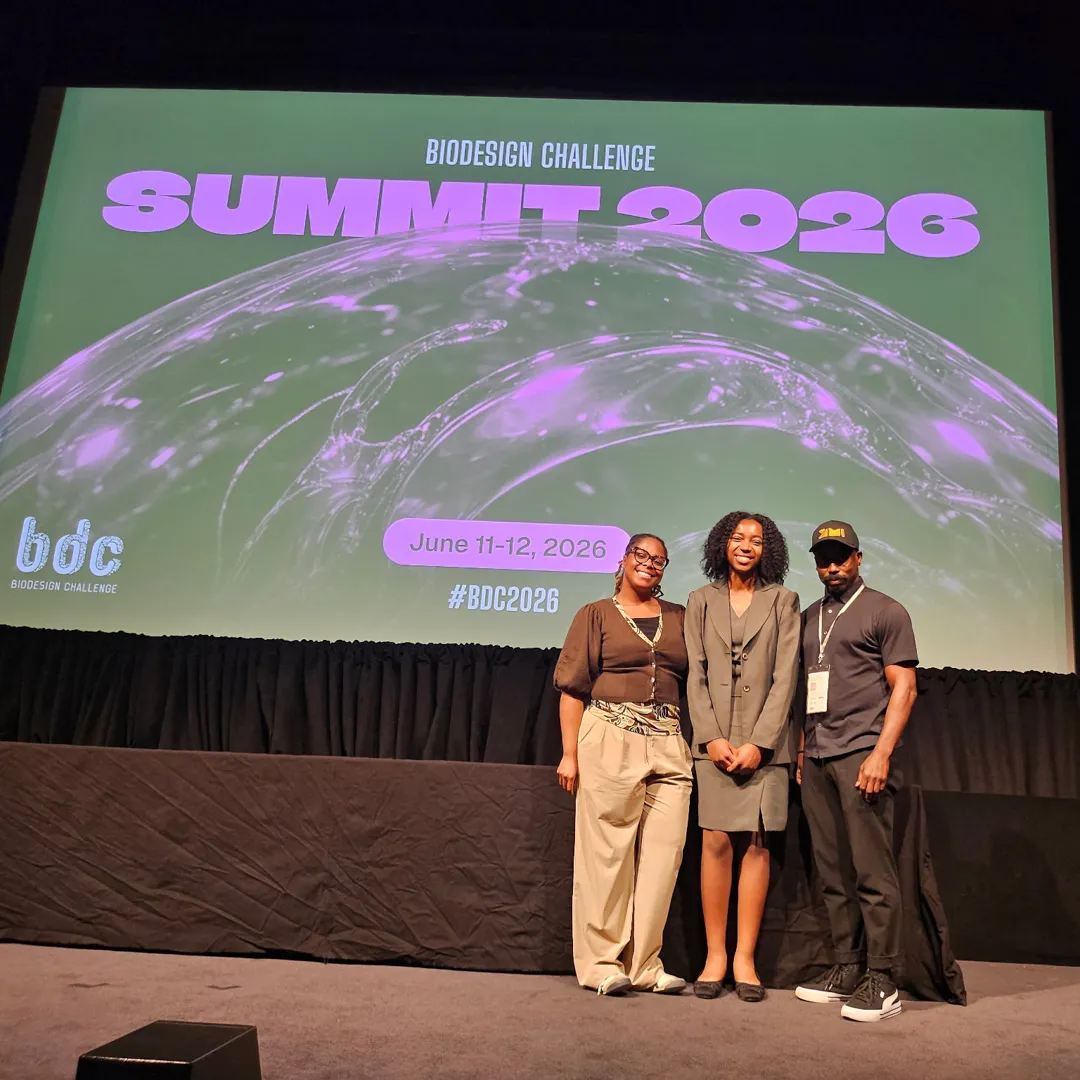
From left, Karri Clay ’27, Nia Griffin ’28 and Professor of Practice Yves Michel at the Biodesign Challenge Summit 2026 (Photo courtesy of Nia Griffin)
A design project fueled by bacteria propelled one Syracuse University team to the Biodesign Challenge Summit 2026.
Developed for Biodesign Sustainable Futures (DES 300), the UQ Generator was a finalist project for the Biodesign Challenge, which exposes high school and college students to the intersection of biotechnology, art and design.
Nia Griffin ’28, an industrial and interaction design major in the College of Visual and Performing Arts, and Karri Clay ’27, a biology and forensic science major in the College of Arts and Sciences, traveled to New York City to showcase the project this June.

The generator uses bacteria to convert hydrogen into energy. Community-focused in its design, one unit is able to power up to five homes.
Both students applied their unique skills to develop the project. Griffin tackled tasks like configuring the business model, completing energy calculations and producing CAD models and renders. Clay studied bacteria strains, analyzed chemical reactions and worked with chemical equations.
“It was my first time engaging in interdisciplinary work, and it made me realize the impact of combining our different skillsets,” Griffin says. “We both gained a deep understanding of our project from the business, design, engineering and biology aspects, which helped us learn more about each other’s fields and perspectives.”
Griffin discovered the value of using microbes as materials. She was further introduced to other elements of biodesign at the summit, where she explored other projects and listened to talks on progress within the field of biodesign.
Throughout the project, Griffin and Clay were guided by Yves Michel, professor of practice of industrial and interaction design in the School of Design, and Carolyn Fernandes ’25, an alumna of the industrial and interaction design program who participated in the summit last year.
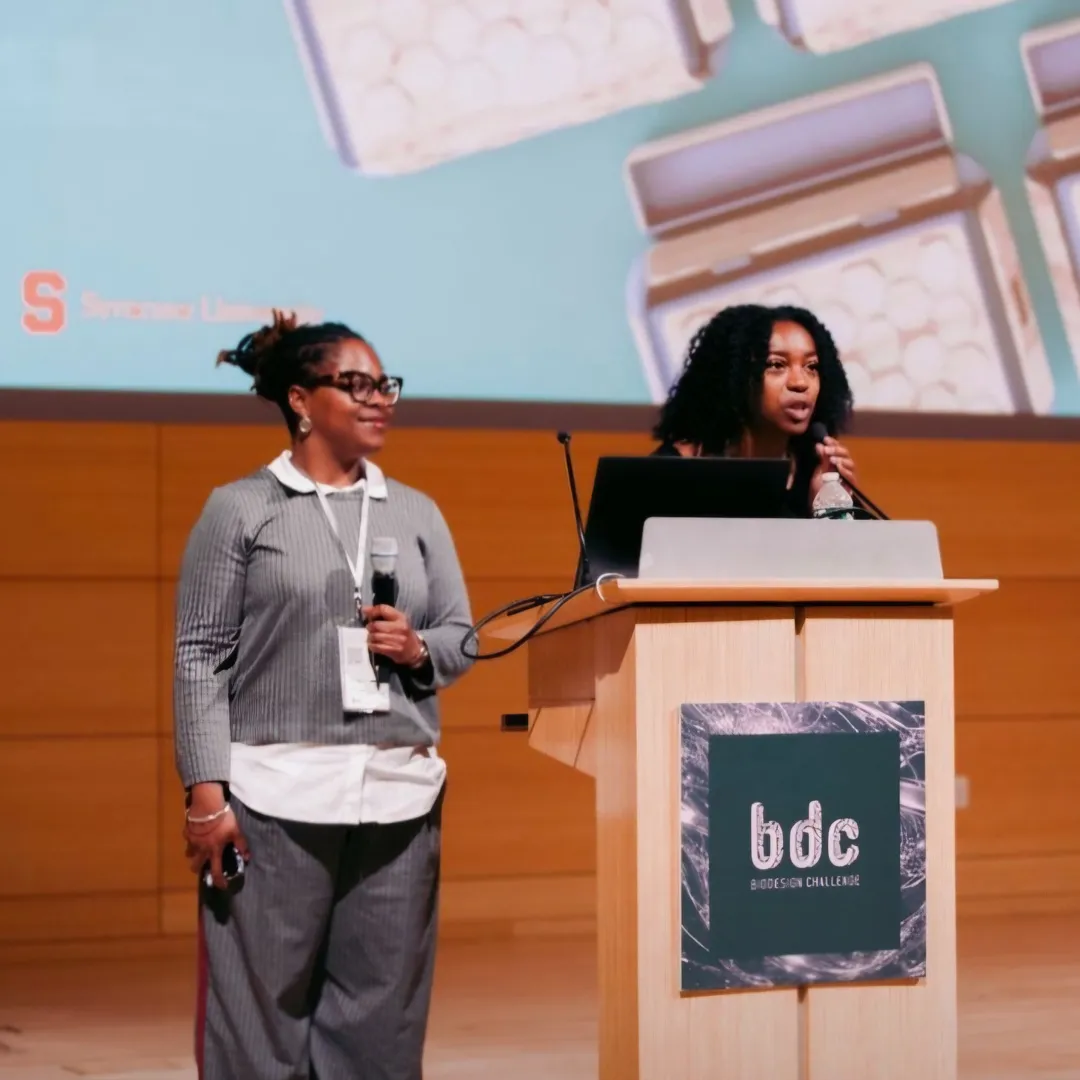
Karri Clay ’27, left, and Nia Griffin ’28 presented their project at the Biodesign Challenge Summit 2026. (Photo courtesy of Nia Griffin)
Classes like Michel’s Biodesign Sustainable Futures course encourage students to confront real-world problems and apply their skills to create solutions.
“With this technology, we aim to promote sustainability, reliability and co-design,” the Griffin-Clay team video notes. “In this way, we propose a more natural, familiar and decentralized method of delivering power to families who rely on unsustainable fuels.”