By continuing to use this site, you agree to the use of cookies in accordance with our privacy policy.

VPA Faculty Research and Creative Activities Symposium

The research and creative scholarship of the College of Visual and Performing Arts (VPA) brings together practice-based inquiry with scholarly rigor. Faculty members engage in diverse forms of creative production and critical research, exploring questions of culture, identity, environment, technology, and social impact. Their work demonstrates how artistic, pedagogical, and scholarly practice strengthen and support one another. The annual VPA Faculty Research and Creative Activities Symposium shares this work with the broader community.
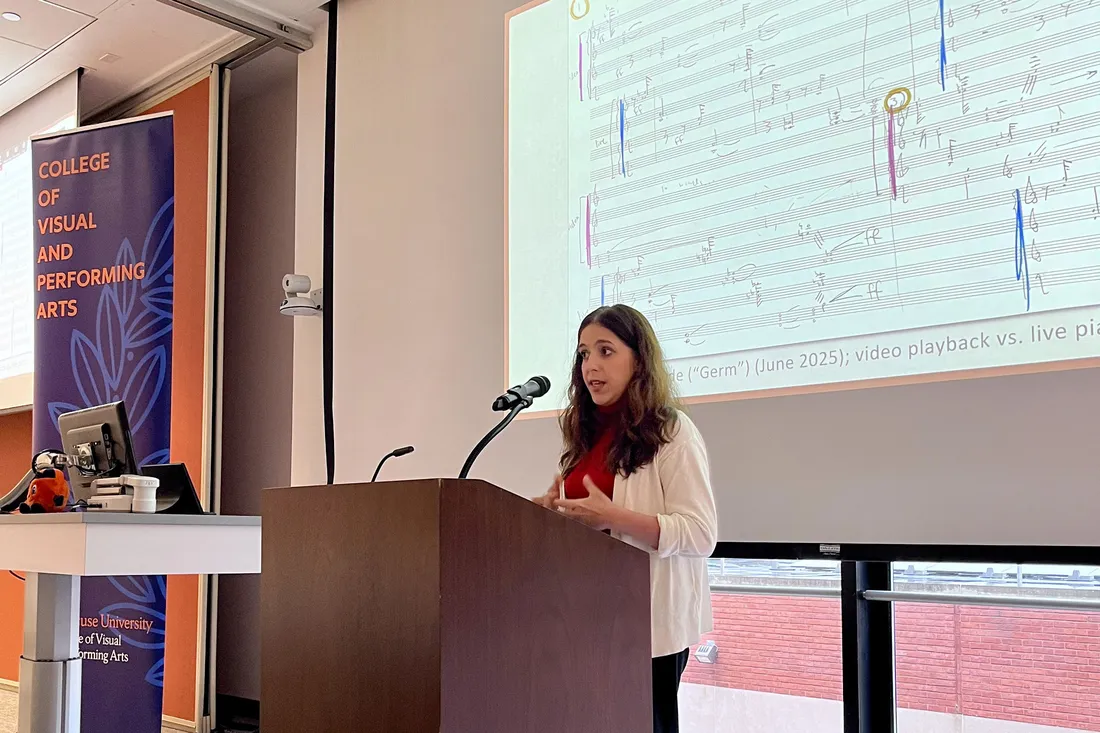
Loren Loiacono stands at a lectern speaking into a microphone. Behind her is a large screen displaying a music score.

Loren Loiacono, assistant professor of composition in the Setnor School of Music, presents on her work "DO NO HARM" at the 2026 symposium.

2026 Symposium Faculty Presenters

The 2026 Symposium was held on Friday, October 2, at Schine Student Center. It featured faculty members from across VPA presenting work completed during their 2025–26 research leaves, as well as recent projects that showcased the depth and range of what they are exploring. It also included early-career faculty who are undergoing third-year review, offering them a platform to share the research and creative accomplishments they have achieved since joining VPA.

Professor, Art Photography
Prof. Sayler’s bio

museum

museum is a photography book and exhibition made during a Smithsonian Artist Research Fellowship. The project explores the ways museums give form to deep time and transform scientific knowledge into public imagination. The fellowship coincided with the dismantling of the iconic Fossil Hall at the Smithsonian National Museum of Natural History. Granted unprecedented access to the process, the artists photographed dinosaurs, dioramas, and displays as they were disassembled, created, and moved. They also gathered images and interviews from scientists and exhibition artists whose work translates paleontological research into visual form. Together, these photographs reveal a museum not as a static repository of facts but as a place where knowledge is continually assembled, revised, and reimagined.

Assistant Professor, Music Education
Dr. DeAngelis’s bio

Expanding the Future of Music Education: A Line of Inquiry Across Four Studies

This presentation provides an overview of four case studies conducted over the past three years that align with goals regarding the future of music education. In the first study, experiences of undergraduate volunteers in a hip-hop music composition program for incarcerated youth were examined; in the second, belonging among collegiate students in an on-campus multimedia production space was explored. The other two studies are currently in progress: one investigates pedagogical strategies of highly engaged modern band teachers, and the other examines the effects of an urban immersion field experience on attitudes of undergraduate preservice music teachers. Together, these studies capture interests in music education across diverse contexts and engage with research to explore and advocate for an ever-expanding vision of music education that embraces a wide variety of learners, spaces, and pedagogies.

Assistant Professor, Acting
Prof. Murphy’s bio

Wolf Women: Building Ensemble through Devised Theater Practices

Wolf Women is a devised physical theater work conceived by Professor Murphy that captures the transformation of women in mythology against the backdrop of the changing wolf population in the Adirondacks. Using physical theater as an instrument to connect primal instincts of survival and nature to the perseverance of women through oppression, Wolf Women asks how we recover the wild within, investigating play as a process of revitalization in society and ecology. This collaborative creation utilizes specially made masks and puppets, shared with the public through both a mask-making workshop and Syracuse University Drama performances. Professor Murphy directs an ensemble of artists, composed of Syracuse University students and experienced devisers, to create a story that captures the transformation of a band of women discovering their own wild power. This work is made possible through the NYSCA Individual Artist Grant, the Faculty Enrichment Fund, and an artist residency with Manifesto Poetico.

Associate Professor, Film
Prof. Suchý’s bio

Made in Syracuse and Beyond

This presentation, titled Made in Syracuse and Beyond, includes a brief introduction, reflections, and updates on the progress—some slow and gradual, others rapid—of three projects pursued during the research leave: @_HOME / DOMA; My Father’s Garden / My Mother’s Room; and Teens with a Movie Camera. The latter received repeated funding from CNYArts, as well as additional support from Syracuse Symposium, the Central New York Community Foundation, and the National Endowment for the Arts. The presentation takes the form of a personal travelogue and includes moments of JOY derived from meetings with Syracuse University alumni.

Assistant Professor, Fashion Design
Dr. Jiang’s bio

Developing a Climate-to-Material Design Process: Material Explorations for Responsive Wearable Art

This presentation documents the first phase of an ongoing practice-based research project exploring how climate data can be translated into responsive wearable textiles. Rather than focusing on a single technique, the project systematically investigated multiple material strategies, including thermochromic screen printing, digital printing with thermochromic overlays, 3D-printed thermochromic filaments, pigment-mixed textile media, and color-changing embroidery. Through material testing and iterative prototyping, the project identified opportunities and constraints of each approach, informing subsequent design decisions. These preliminary studies establish a material-based design process that connects climate information with embodied wearable experiences, laying the foundation for garment-scale development and future creative research.

Assistant Professor, Musical Theater
Prof. Wrinn’s bio

The Classroom as Creative Laboratory: Workshopping A New Musical Commission with Students

This presentation focuses on the collaborative workshop process that grew out of Professor Wrinn's 2025 NYSCA theater commission for her musical, The Bridge. While writing and composing a new draft of the work, Professor Wrinn brought the unfinished script and score into her course, DRA 300: Workshopping New Musicals, using the classroom as a live laboratory to develop scenes and songs with undergraduate musical theater and acting students. The presentation examines how student performances, analysis assignments, and feedback shaped decisions in the material, and how this integration of research and teaching led to an invitation to present at Yale's Innovation Summit in May 2025, where work developed through the course was showcased with the students. As one example of Professor Wrinn's broader research on developing new musicals in university theater programs, this presentation considers the impact universities can have on creation and innovation in the theater arts.

Assistant Professor, Illustration
Prof. Luscher’s bio

Lived Experience through Sequential Comics 

Professor Luscher is an author and illustrator specializing in sequential comics. Her long-form graphic novel work often explores original perspectives through distinctive characters, with developing work focused on characters navigating trauma through multiple genres, including horror as a lens for revealing everyday monsters in political and social systems.

Professor Luscher is also engaged in the emerging field of graphic medicine and the use of comics to depict medical experiences. In 2025, she created and edited Body: An Anthology, which contains 31 stories by artists from around the world, including artists from Syracuse University and Upstate University, focused on the human experience. She is continuing to develop short-form comics around her own experiences with Polyendocrine Metabolic Ovarian Syndrome, exploring how lived experiences and often-unseen moments can become sources of connection through image and story.

Assistant Professor, Music Composition
Dr. Loiacono’s bio

DO NO HARM

DO NO HARM is a large-scale work for two pianists and video projection, premiered at Syracuse University's Hendricks Chapel. Created in collaboration with piano duo HereNowHear, DO NO HARM examines the experience of chronic illness through the lens of the performer-instrument relationship. Through a series of musical scenarios that push the limits of musical technique, the pianists explore the tension between the perfectionist mindset of classical music training and the inherent frailty of the human body.

Associate Professor, Communication and Rhetorical Studies
Dr. Sierra’s bio

Singing in Conversation

Singing has been argued to be somewhat rare in everyday conversation (Azios & Archer 2018). However, researchers have found that singing is often jointly produced, can be used for complimenting, managing the distribution of knowledge, constructing humorous identities (Warnock 2015), facework (Azios & Archer 2018), sequence closings, relieving tension and giving rise to new topics (Frick 2013), and requesting, informing, and sharing (Stevanovic & Frick 2014). This presentation builds on this work with data from an interactional sociolinguistic study on intertextual media references among friends and family. Examples involving the singing of melodies and/or lyrics from films, TV shows, and recorded songs are examined. The presentation contributes to research on singing in interaction by showing how singing resolves interactional dilemmas via epistemic frame shifts and can also be used for play, rapport, and reinforcing group norms. Ultimately, singing contributes to managing alignments and constructing identities.

Associate Professor, Film
Prof. Moradian’s bio

Beyond the Screen: ‘The Mermaid’ – Interdisciplinary Collaboration for Social Awareness

This presentation explores how The Mermaid evolved from a feature film into an interdisciplinary platform for education and social awareness. The production brought together Syracuse University students and faculty across disciplines, working alongside industry professionals in a collaborative, real-world environment. Supported by a NYSCA grant, the project expanded beyond the screen through a series of public screenings and conversations across New York addressing domestic violence, emotional abuse, trauma, and resilience. These events brought cinema into dialogue with mental health, education, advocacy, and community engagement, demonstrating how interdisciplinary creative practice can extend the impact of filmmaking and create meaningful spaces for public dialogue and social awareness.